
A parking barrier gate system consists of multiple mechanical and electrical components working together to control vehicle access.
Understanding how each part works helps identify faults quickly and prevents unnecessary damage to the barrier system.
This guide explains the main barrier components, their function, and what happens when each part fails.
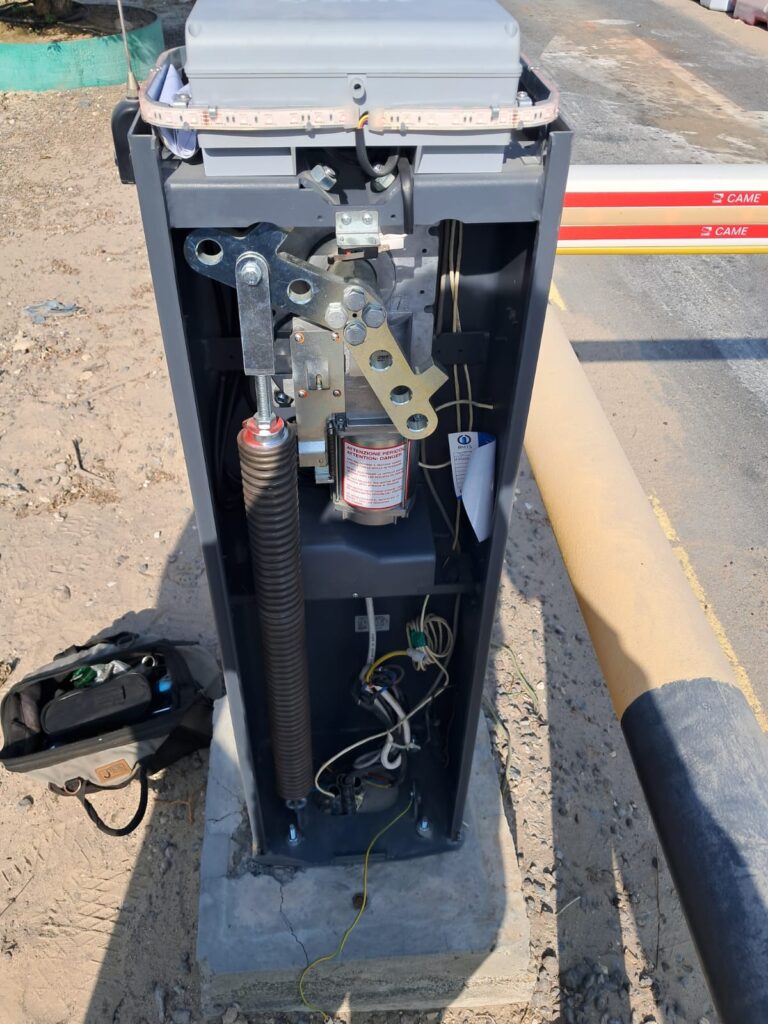
Barrier Motor
Function
The motor is the main driving component of the barrier system. It generates the force required to move the barrier arm through the gearbox and lifting mechanism.
What happens in real operation
When a trigger is received (remote, loop, push button), the motor starts and transfers movement to the gearbox, which then lifts or lowers the barrier arm.
When the motor starts failing
From field reality, you usually don’t see a “dead motor” immediately. It shows symptoms first:
- Barrier opening becomes slow
- Motor produces humming sound
- Barrier struggles to lift arm
- Works sometimes, fails sometimes
- Overheating after few operations
Common causes of motor-related issues
- Weak or failing capacitor
- Overload due to poor spring balance
- Continuous heavy usage
- Voltage fluctuation
- Internal winding wear
When the motor becomes weak or overloaded, the barrier may start operating very slowly during opening or closing cycles.
Gearbox (Drive System)
Function
The gearbox transfers the motor’s rotation into controlled movement of the barrier arm. It reduces speed and increases torque so the arm can lift and lower smoothly.
What happens in real operation
When the motor starts, the gearbox converts high-speed rotation into steady mechanical movement, allowing the barrier arm to move with controlled force.
When the gearbox starts failing (real field behavior)
- Motor runs but arm does not move
- Barrier arm moves slightly then stops
- Grinding or abnormal mechanical noise
- Barrier stops before reaching full open/close
- Oil leakage visible from gear motor
Main real cause from field (important)
One of the most common causes of gearbox damage is incorrect speed adjustment.
When the barrier moves too fast, it may hit the mechanical stopper before reaching the limit switch.
In this situation:
- The barrier arm stops physically
- But the gearbox is still rotating internally
- The pinion teeth start scraping repeatedly
Over time this leads to:
- Gear wear
- Internal damage
- Oil leakage from gear motor
This is a progressive failure — not instant.
Other contributing causes
- Incorrect limit switch adjustment
- Mechanical stopper misplacement
- Continuous overload due to poor arm balance
- Lack of maintenance
As gearbox damage increases, the motor may continue running while the barrier arm fails to move properly.
Spring Balance System
Function
The spring balance system supports the weight of the barrier arm and reduces the load on the motor and gearbox.
What happens in real operation
The spring is adjusted to counterbalance the barrier arm weight. When correctly set, the arm can move smoothly with minimal load on the motor.
Technicians usually check balance by positioning the arm around 45 degrees, where it should remain stable without falling or rising.
When the spring balance is incorrect
This is very common in the field:
- Barrier opening becomes slow
- Barrier closing becomes too fast
- Arm drops suddenly during closing
- Motor works under heavy load
- Gearbox stress increases
- Long-term mechanical damage starts
Real field impact
If the spring balance is not correct:
- The motor is forced to carry extra load
- The gearbox experiences unnecessary stress
- The barrier speed becomes unstable
Over time this leads to:
- capacitor failure
- gearbox wear
- arm misalignment
- bracket loosening
When the spring balance is not properly adjusted, the barrier may start operating slowly and place excessive load on the motor.
Barrier Arm and Arm Bracket
Function
The barrier arm blocks or allows vehicle access, while the arm bracket connects the arm securely to the drive shaft and gearbox system.
What happens in real operation
When the motor and gearbox rotate, the movement is transferred through the shaft to the arm bracket, which then lifts or lowers the barrier arm.
The bracket must remain tight and properly aligned to ensure smooth and stable movement.
When problems start (real field behavior)
This is very common in the field:
- Barrier arm moves irregularly
- Arm shakes during operation
- Arm slips or does not follow motor movement
- Visible looseness at the arm connection
- Barrier becomes unstable over time
Main real cause
One major reason for arm bracket problems is continuous mechanical stress from gearbox impact.
When the barrier hits the mechanical stopper before reaching the limit switch:
- force is transferred back into the system
- gearbox and shaft take impact
- arm bracket gradually becomes loose
Over time:
- alignment is lost
- movement becomes unstable
- connection weakens further
Other contributing causes
- Improper installation of arm bracket
- Incorrect arm length or weight
- Poor spring balance increasing load
- Continuous heavy usage
When the arm bracket becomes loose, the motor may rotate normally while the barrier arm fails to move correctly.
Limit Switch
Function
The limit switch defines the stopping points of the barrier arm at fully open and fully closed positions.
What happens in real operation
As the barrier arm moves, the limit switch signals the control board when the arm reaches its correct position. This ensures the motor stops at the right time without hitting mechanical limits.
When the limit switch is not working properly
Very common field behavior:
- Barrier does not stop at correct position
- Barrier stops before full opening or closing
- Barrier hits the mechanical stopper
- Barrier gets stuck midway
- Movement becomes inconsistent
Main real issue
When the limit switch is misaligned or not detecting correctly:
- the barrier continues moving beyond its correct position
- it may hit the mechanical stopper before stopping
- repeated impact creates stress on gearbox and internal components
This is one of the main reasons for:
- gearbox damage
- arm bracket loosening
- unstable operation
Other contributing causes
- Loose or shifted limit switch position
- Wiring faults in limit switch circuit
- Mechanical wear or sensor failure
- Incorrect adjustment during installation
When the limit switch fails to detect the correct position, the barrier may stop midway or continue opening and closing repeatedly without completing a proper cycle.
Photocell (Safety Sensor)
Function
The photocell is a safety device that prevents the barrier from closing when an obstacle, vehicle, or person is detected in the path.
What happens in real operation
The photocell works using a transmitter and receiver. When the beam between them is clear, the barrier operates normally. If the beam is interrupted, the controller blocks the closing movement for safety.
When photocell problems occur (real field behavior)
Very common cases you mentioned:
- Barrier does not close
- Barrier stops during closing
- Barrier behaves unpredictably
- System appears normal but does not respond correctly
Main real causes from field
Heat damage and aging
In Dubai conditions, photocell covers often fade or degrade due to heat and sunlight. Over time this affects internal components and signal accuracy.
Internal misalignment after impact
Photocells are frequently hit by vehicles, trolleys, or pedestrians.
Even if the outer body looks fine, the internal alignment or circuit direction may shift. This causes incorrect signals to the controller.
Photocell beam blocked without user awareness
In many cases, objects such as equipment, signboards, or parked vehicles block the beam.
The system then prevents the barrier from closing, but the user assumes the barrier is faulty.
Other contributing causes
- Loose wiring connections
- Water or dust inside sensor housing
- Poor installation alignment
- Cable insulation damage
When the photocell beam is blocked or the sensor is faulty, the barrier may refuse to close as part of its safety protection system.
Loop Detector
Function
The loop detector identifies the presence of a vehicle using an inductive loop installed in the ground. It sends a signal to the barrier controller to trigger opening or prevent closing.
What happens in real operation
When a vehicle passes over the loop, the detector senses a change in magnetic field and sends a signal to the control board.
This signal is used for:
- opening the barrier (entry/exit)
- preventing the barrier from closing when a vehicle is present
When loop detector problems occur (real field behavior)
Very common situations from your experience:
- Barrier does not close
- Barrier opens and closes repeatedly
- Barrier triggers even when no vehicle is present
- Some vehicles detected, others ignored
- System works inconsistently
Main real causes from field
Incorrect sensitivity and frequency adjustment
Loop detector settings must be properly calibrated.
If sensitivity is too high or frequency is not set correctly:
- false triggers may occur
- barrier may detect vehicles even when lane is empty
- unstable operation starts
Vehicle detection can also vary depending on ground clearance, where some vehicles (like SUVs) may not be detected properly.
Poor loop installation (important field point)
Correct loop installation requires multiple cable turns inside the ground slot.
- Proper installation: around 4 turns
- Poor installation: only 2 turns
With fewer turns:
- signal becomes weak
- calibration becomes difficult
- long-term stability is reduced
As the system ages, this leads to unreliable detection.
Loop cable damage or insulation failure
Loop cables can degrade over time due to:
- heat
- moisture
- physical damage
Damaged insulation may cause:
- signal fluctuation
- false detection
- continuous triggering
Other contributing causes
- Electrical interference
- Poor grounding
- Controller setting mismatch
- Aging loop detector module
When the loop detector sends a continuous or unstable signal, the barrier may refuse to close because the system detects a vehicle even when the lane is clear.
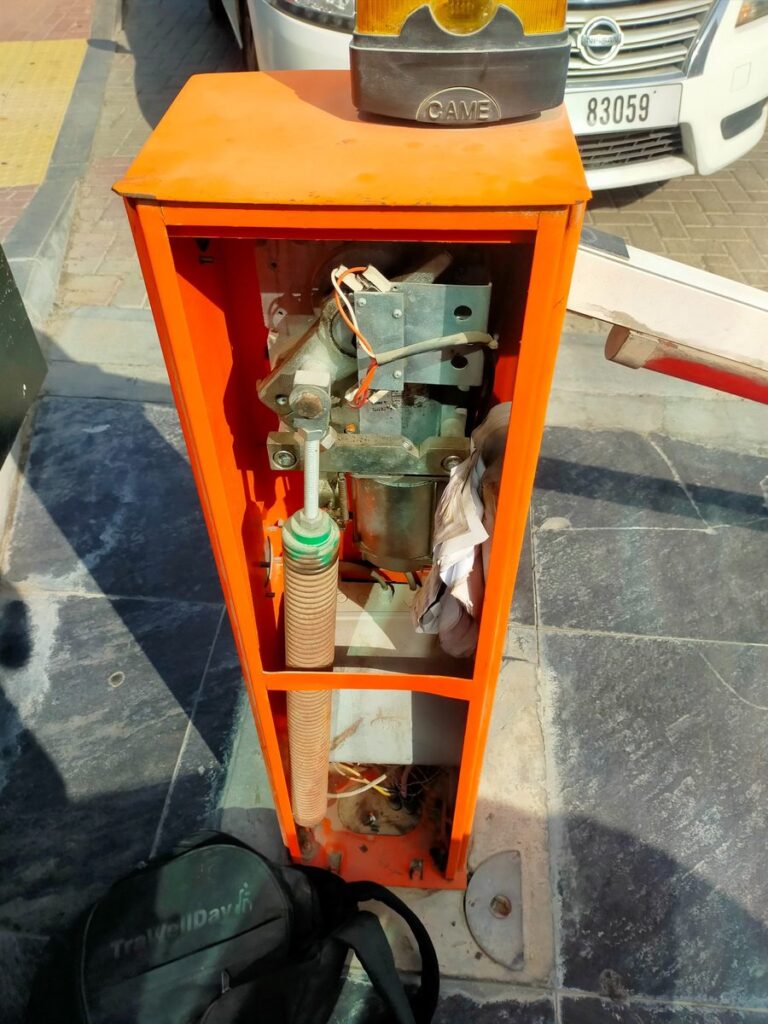
Control Board
Function
The control board is the main unit that manages all barrier operations. It receives signals from devices such as remotes, loop detectors, and photocells, and controls the motor and movement of the barrier.
What happens in real operation
Every action of the barrier depends on the control board.
- Trigger received → board processes signal
- Safety input checked → decision made
- Motor activated → movement starts
If the control board is not functioning correctly, the entire system becomes unstable or unresponsive.
When control board problems occur (real field behavior)
This matches what you said:
- Barrier completely not responding
- No reaction to remote or push button
- Random operation
- Barrier stops working suddenly
- System behaves unpredictably
👉 In simple terms:
No control board → no barrier operation
Main real causes from field
Relay sticking inside control board
Sometimes internal relays get stuck.
- Barrier may start working after power reset
- But problem returns again
This is usually a temporary recovery, not a real fix.
Accessory fuse failure (important point you mentioned)
Very common mistake by inexperienced technicians:
- Control board looks normal
- LED indicators are ON
- But accessories are not receiving power
This happens when the accessory fuse is blown.
Input/output signal failure
- Remote signal not processed
- Loop detector input ignored
- Photocell input not responding
This causes unpredictable or no operation.
Voltage fluctuation or electrical disturbance
- sudden shutdown
- unstable behavior
- damage to internal components
Especially in systems connected to external signals like fire alarm systems.
When the control board fails, the barrier may stop immediately at any position, whether fully open, fully closed, or midway during operation.
In this condition, the system will not respond to any trigger because all control signals are managed by the control board.
Capacitor
Function
The capacitor helps the motor start and provides the initial torque required for smooth barrier movement.
What happens in real operation
When the barrier receives a trigger, the capacitor supports the motor during startup, allowing it to begin rotation smoothly and with enough force.
When capacitor problems occur (real field behavior)
Very common signs:
- Motor produces humming sound
- Barrier starts very slowly
- Barrier struggles to lift the arm
- Movement becomes weak or inconsistent
- Motor runs but with low power
Main real cause from field
When the capacitor becomes weak:
- starting torque reduces
- motor cannot generate enough force
- barrier movement becomes slow or unstable
In some cases:
- motor runs but cannot lift the arm properly
- repeated attempts increase motor load
When the capacitor becomes weak, the motor may run with reduced power, causing slow or unstable barrier movement.
Receiver (Remote Module)
Function
The receiver module receives signals from the remote control and sends a trigger command to the control board to operate the barrier.
What happens in real operation
When a remote button is pressed:
- signal is sent to the receiver
- receiver passes the command to the control board
- barrier starts opening or closing
When receiver problems occur (real field behavior)
Very common situations:
- Remote not working
- Barrier does not respond to remote
- Remote LED works but no barrier movement
- Short operating range
- Works sometimes, fails sometimes
Main real causes from field
Receiver module fault
The receiver unit may fail internally or stop processing signals.
Antenna or signal issue
- Damaged or missing antenna
- Weak signal reception
- Interference from nearby devices
Programming or memory issue
- Remote lost from memory
- Receiver reset
- Incorrect frequency
Wiring problem
- Receiver connected but signal not reaching control board
- Loose or damaged wiring
When the receiver fails to process signals correctly, the barrier may not respond to remote commands.
Encoder (Position Feedback System)
Function
The encoder tracks the position and movement of the barrier arm and sends feedback to the control board to control stopping points and movement accuracy.
What happens in real operation
As the barrier arm moves, the encoder continuously sends position data to the control board.
This allows the system to:
- control opening and closing limits
- stop the barrier at the correct position
- manage smooth and controlled movement
When encoder problems occur (real field behavior)
From what you described:
- Barrier keeps opening and closing repeatedly
- Barrier does not stop at correct position
- Barrier hits mechanical stopper
- System becomes unstable during operation
- Barrier overloads and stops
Main real cause from field
When the encoder is faulty or incorrectly programmed:
- the control board cannot track barrier position correctly
- movement becomes uncontrolled
- barrier may continuously cycle (open/close)
- system fails to recognize correct stopping points
In some cases:
- the barrier reaches the mechanical stopper
- but the system still does not detect the correct limit
- continuous operation causes overload
- eventually the barrier stops in open position
When the encoder fails to provide correct position feedback, the barrier may continue opening and closing repeatedly without stopping at the correct position.
👉 Related Barrier Problems
Barrier Gate Not Opening
Barrier Gate Not Closing
Barrier Gate Opening Slowly
Barrier Gate Closing Too Fast
Barrier Motor Running but Arm Not Moving
Barrier Gate Stuck Halfway
Barrier Flashing Light but Not Opening
Barrier Remote Not Working
Loop Detector Not Detecting Vehicle
Barrier Opening Automatically
Need Barrier Gate Repair in Dubai?
If your barrier system is not working correctly, our technicians provide on-site inspection and repair across Dubai.
We diagnose mechanical, electrical, and control system faults to restore reliable operation.